
Even before it faces the confidence vote in the Lok Sabha, the government will brief the International Atomic Energy Agency board of governors in Vienna on July 18 on the India-specific safeguards agreement, which the board is likely to discuss on August 1 to help the implementation of the Indo-US nuclear deal. India on Monday informed the 35 member-countries on the board of governors about the July 18 briefing, IAEA sources said.
If the government has the courage to defy its leftist allies, there is no better time to tackle these issues than now.
The remarks came as Left parties asked the Union government to have David C Mulford recalled while Opposition BJP sought an all-party meet over the controversial remarks by the US Ambassador to India on the Iran issue.
International experts reaching Vienna for the 51st general conference of the IAEA are understood to be keen to know about the opportunities likely to emerge if the Indo-US civil nuclear deal goes through.

The United States has lifted most of its sanctions against Iran after a UN watchdog reported that Tehran had complied with a nuclear weapons deal.
Signalling the continuity of policy, the new government has ratified the Additional Protocol, a commitment given under Indo-US nuclear deal by the previous dispensation to grant greater ease to International Atomic Energy Agency to monitor India's civilian atomic programme.

The crises of the 21st century, 9/11, the economic meltdown, COVID-19, Russia-Iran war and the Hamas-Israel war seem to be never ending. In this situation, Iran might be contemplating a nuclear deterrent to defend itself, observes Ambassador T P Sreenivasan, the distinguished long-time Rediff contributor who turns 80 on June 17..
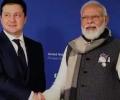
Prime Minister Narendra Modi spoke with Ukrainian President Volodymyr Zelenskyy on Tuesday and asserted that there can be no military solution to the Ukraine conflict, while also underlining that endangerment of nuclear facilities could have catastrophic consequences.

The Chernobyl nuclear power plant, which was taken over by Russian forces last month, has stopped transmitting data to the International Atomic Energy Agency (IAEA), the United Nations atomic watchdog has said, expressing deep concern for the staff working under Russian troops at the nuclear site in northern Ukraine.

The Nobel Prize for Malala may have caused deep divisions across the globe and disturbed the peace, while the award to OPCW, though not without critics, may have served the cause of peace by eliminating a weapon of mass destruction from the face of the earth, says Ambassador T P Sreenivasan.
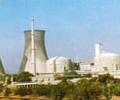
Scientists are puzzled by what caused the mysterious nuclear leak at the Kakrapar Nuclear Power Plant in Gujarat last year, reveals Pallava Bagla.

R K Narayan's house has been preserved as a simple museum with his memorabilia, thanks to the imagination of a commissioner of Mysore, who stopped its sale by RKN's successors to a property developer and purchased it for the government.

Informing the world leaders of measures taken by him, Modi said India will continue to accord a high national priority to nuclear security through strong institutional framework, independent regulatory agency and trained and specialised manpower.

India has voted against the provisions of draft resolutions that would have required it to accede to the Nuclear Non-Proliferation Treaty, saying there is "no question" of it joining the treaty as a non-nuclear weapon state.

'Castro told us: "Give me a thousand Gurkhas and I shall keep my neighbour under control!"' 'We pretended that we did not know which neighbour he meant.'

'He always had a choice to resign and walk toward the sunset in protest.' 'Instead, he chose to be a mute witness to one of the most sordid chapters of India's parliamentary history when MPs were bought up like cattle to steer the nuclear deal through,' says M K Bhadrakumar.

No theory would ever justify the public humiliation of the acting head of the consulate of a friendly country. Whatever be the eventual solution, grievous damage has been done to her personally and to the relations between the two countries, says Ambassador T P Sreenivasan.

The powerful United Nations Security Council on Monday unanimously adopted a resolution that endorses the landmark nuclear deal between Iran and six world powers.

'The biggest lacuna in this agreement is it is called 'full civil nuclear cooperation agreement.' Actually, it is anything but full.'

The reversal of Trump's policy with regard to Iran, like the withdrawal from the Paris Agreement, may not be a matter of just turning the clock back, but one of patient negotiations, with uncertain consequences in the post-COVID-19 world, observes Ambassador T P Sreenivasan.

'Clearly, from the Indian viewpoint, the US retrenchment from Asia cannot be happening as good news.' 'The abandonment of the US' pivot to Asia exposes the US-Indian partnership to be a mere transactional relationship,' says Ambassador M K Bhadrakumar
